Hey Reader,
A few days ago, Karho Leung (from 12 Pell) and I had a conversation. As always, we talked about a lot of things. After the call ended, I started reflecting on the game exchanged. To be honest, it was good. So good that I was inspired to write this and share it with you.
The conversation started with the two of us, but if you have anything to add to the conversation, please chime in.
“All that glitters isn’t gold.” Ain’t that the truth.
Social media feeds are feeding fools gold. The walls of the echo chamber are so thick…we can’t hear the real ones trying to tell us to stop listening. This is the world we live in.
A world where I sold my 2010 Hyundai Elantra to a college student and two weeks later he posted in front of a Benz. A world where gurus sell online courses but fumble through giving a live lecture. A world where the feed makes it seem like they're making a lot of money but then you meet them and they tell you they’re barely scraping by.
They say ‘Never meet your heroes’ but I actually think that meeting your heroes is the only way to cut through the noise. And that’s probably for the best.
If online is where you flex, then offline is where your credit gets checked.
Over the last 6 years, the barber industry has been flooded with content creators. For a moment, it seemed like everyone was trying to become an ‘educator’ and launch an online course. These online personalities were teaching everything from haircut tutorials to marketing strategies that would lead to becoming a ‘6-figure barber’. If your algorithm caught wind of your interest in barbering, it might have been game over for you. You were binge watching the tutorials, you started cutting friends and family, eventually signed up for barber school and then found yourself licensed.
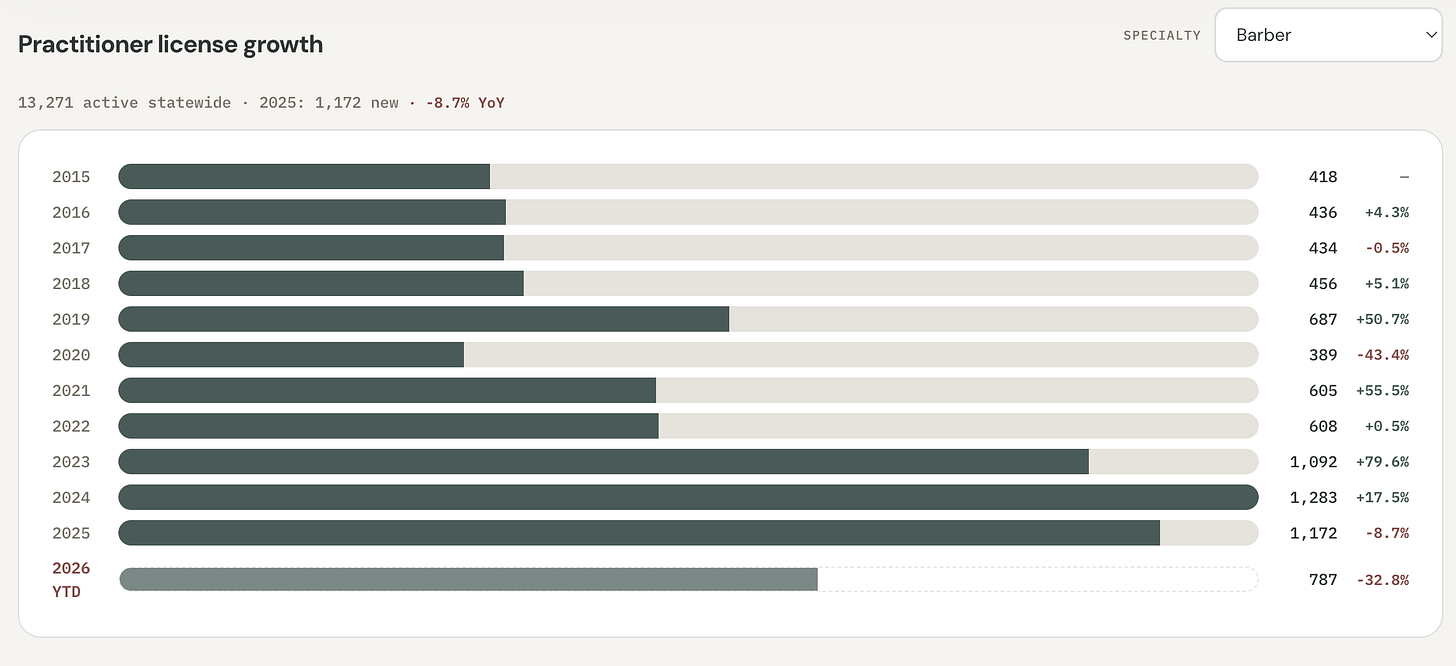
From 2022 to 2023, New York alone saw a 79% increase in newly licensed barbers. The growth continued from 2023 to 2024, climbing an additional 17% year over year. In those two years, there were more newly licensed barbers than the previous four years combined.
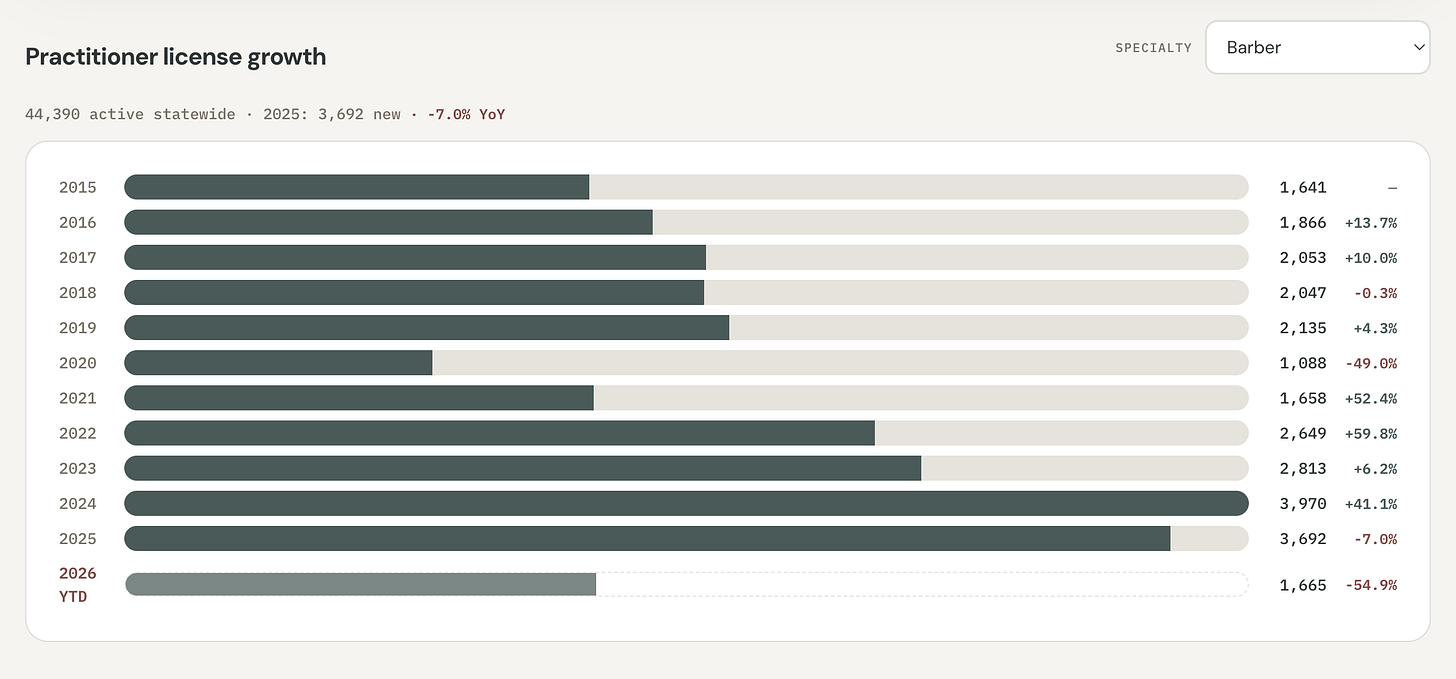
On the west coast, California saw a 60% increase in newly licensed barbers from 2021 to 2022. And then another 40% increase from 2023 to 2024. Something caused a massive spike from coast to coast. So, what exactly happened?
Let’s take a trip down Instagram memory lane.
In the early days, Instagram fed us posts from accounts we followed in a reverse chronological order. The content was only photos as well. No videos, no stories, no reels. Just photos and just our friends.
Eventually, they ditched the reverse chronological order and started showing us the best posts from people we follow. They predicted what matters most to us from people we follow and put that in our feed.
Then the slope started to get really slippery. They started showing us posts and reels from people we didn't know about, but thought we might like. They factored in our engagement and used that to influence our feed. We started to see suggested content for the first time.
We eventually ended up in a continuous algorithm loop where we’re shown what they ‘know’ we like. We have little control and soon enough our feeds are feeding us the similar messages over and over from various voices that can create fake validation.
Like I said earlier, if online is where you flex, then offline is where you credit gets checked.
Disrupt the Loop
The only way to disrupt the continuous algorithm loop is to get out of the algorithm. The only way to see if you’re dealing with fools gold is to physically hold it and inspect it yourself.
Online, it seems like everyone has motion. Offline, it takes seconds to realize it was just a show.
It’s happened many times at this point. I’ll meet people with large followings in person and realize it’s all hype. The content online might be quality, but it’s curated. It’s edited. And there’s no editing when you’re in person. I’ve sat in the crowd and watched barber educators with huge followings online, flounder on stage while teaching a haircutting class.
This might be why the pendulum has swung towards real life gatherings. We feel the online fatigue. We acknowledge the continuous algorithm loop and want out. That’s why companies like Brick exist. It’s why schools are talking about cutting out screens completely from their curriculum or transitioning to a phone-free recess and lunch hour.
We’ve come a long way from reverse chronological feeds featuring posts from our friends. However, as I look out onto the horizon, I see a world where we learn to balance the online glitter with the offline gold.
Community is Essential
It’s something that can’t happen alone. Community is essential. “If you want to go fast, go alone. If you want to go far, go together.” Teams will almost always out perform individuals. Brands like 12 Pell, Paradox and STMNT are teams.
There are many OGs in the barber industry who don't engage online. Why? Are they are too busy serving their community? Maybe the thought is: Why listen to an online guru when I can listen to the guru sitting in their barber chair? aka my clients who have game to share.
The intersection of this whole conversation is in-person community. Real conversations with real people. In person, we see if the Porsche is actually parked out front or not. We see if the online content was the tip of the iceberg or the whole shabang. We see if their barbershop is actually booked and busy, or just appeared to be.
When it comes to connection, we typically prefer spending time in person than Zoom. That’s where the real, unedited story takes place. Before it’s been filtered, edited and optimized for the feed. If we fast forward to the end of our days, I’m sure it’s the real life stories we’ll be telling vs the ones that happened online.
Shift Towards IRL
Brands are picking up on this too. Marketing teams are shifting towards unique real life activations that spark emotional connection. Participants show up wanting to experience something in real life that they’ll be compelled to post about later. And then the feed will be filled, making viewers want to be part of it. But the movement sparked in person and spread online.
Maybe it comes down to this. Would you rather have been in the room when it sparked? Or just heard about it later online? I know my answer, what’s yours?
Written by: Matthew Mendoza
Was this email forwarded to you? Sign up here.